The company’s new frontier model bets on agents capable of working for days, visual intelligence, and long-running tasks. An open 27-billion-parameter version brings some of those capabilities to home computers.
Max: Alibaba’s frontier model
Qwen 3.8 Max is the most advanced model in the Qwen family. It uses a Mixture of Experts architecture with 2.4 trillion parameters in total — around 95 billion are activated per inference — and offers a context window of up to 1 million tokens.
The highlight of the launch is autonomy. In one of the tests presented by Alibaba, the model worked for more than ten days developing and improving a software project without human intervention. In another, it competed against 526 teams and, according to the company, outperformed 458 of them — the equivalent of 87% of the human teams.
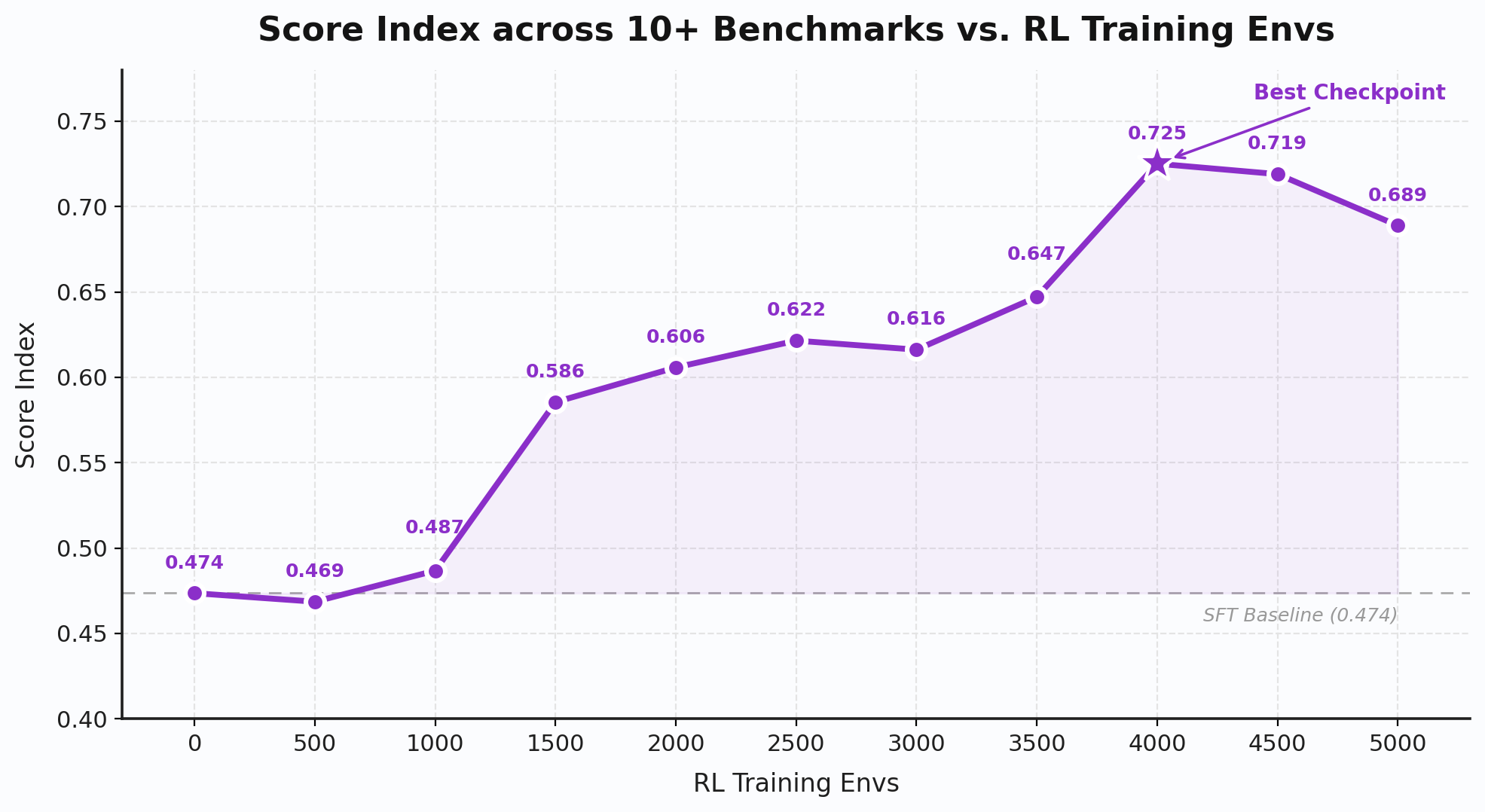
According to Alibaba, gains on in-house and public benchmarks remain consistent as reinforcement learning training continues to scale.
Focus on tasks that are not just complex, but long-running
The launch material dedicates more space to prolonged use cases than to isolated demonstrations. The goal is to show a model capable of maintaining objectives, interpreting results, and correcting its strategy over hundreds or thousands of interactions.
The examples span programming, research, professional work, chip design, and business simulations. What they all have in common is that they involve cycles of execution, evaluation, and correction, with little or no human participation. Alibaba positions Qwen 3.8 Max as an agent for complete projects, not just a chatbot that answers one-off tasks.
Visual intelligence
Vision is also no longer just a form of input. Qwen 3.8 Max can analyze PDFs with more than 200 pages, interpreting text, charts, and the visual organization of the document. The company also promises processing of videos over 100 hours long.
While executing a task, the model can observe its own results, identifying misaligned interfaces, objects in incorrect positions, or differences from the requested design. This visual information becomes part of the planning, execution, verification, and correction cycle.
Benchmarks
The benchmarks were divided into programming, general agents, traditional reasoning capabilities, and different forms of multimodal intelligence. The visual tests cover everything from documents and spatial perception to interface control, application creation, and long-video understanding.
In programming and agents, Qwen 3.8 Max comes close to the leading closed models, but shows a significant leap over the previous generation. The biggest advantages appear in the visual, document, and multimodal reasoning categories.
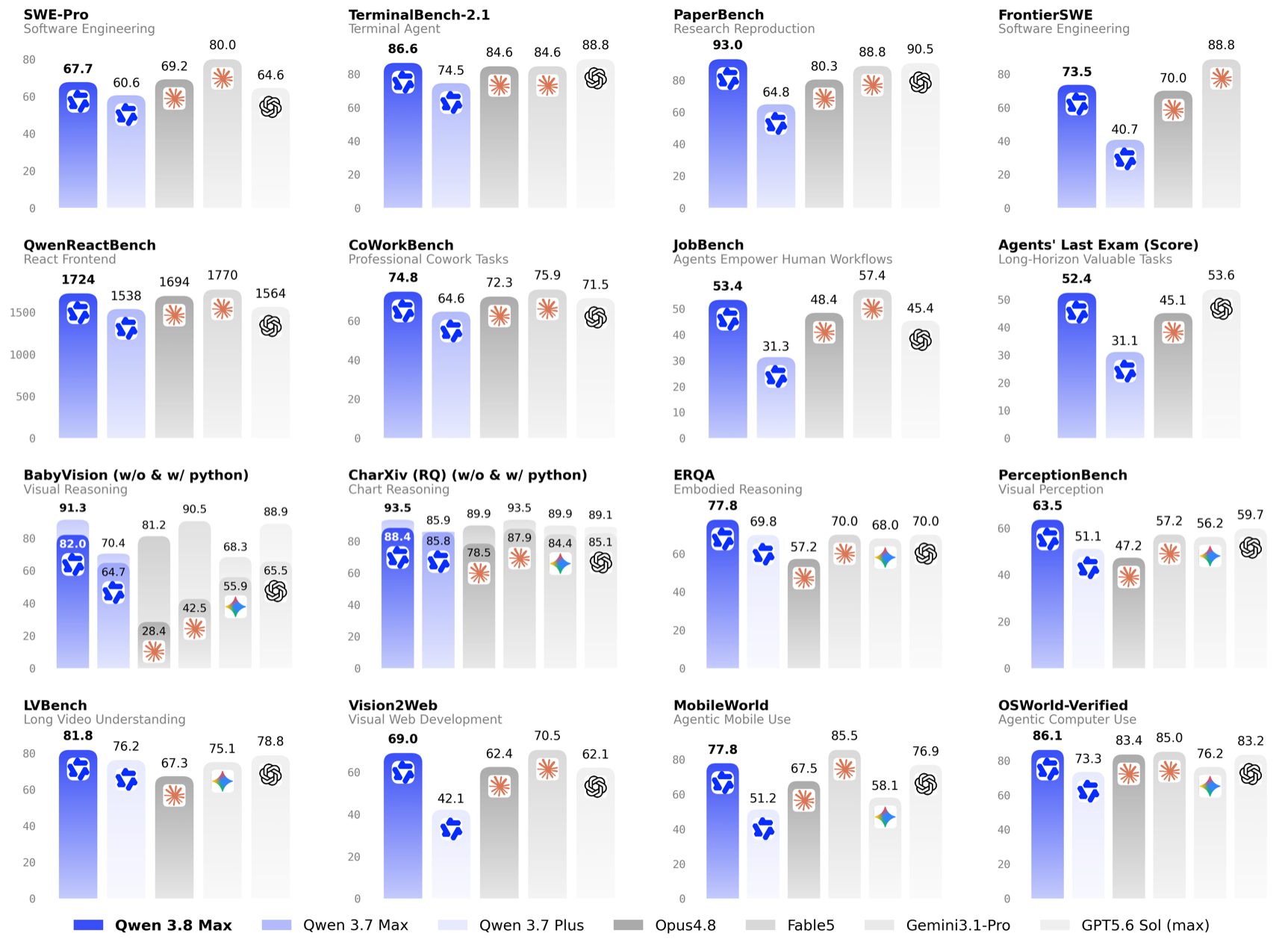
Official results published by Alibaba on coding, agent, vision, and video understanding benchmarks.
| Category | vs. Opus 4.8 | vs. Fable 5 | vs. GPT-5.6 Sol | vs. previous Qwen |
|---|---|---|---|---|
| Coding agent | -0.3% | -8.1% | -0.1% | +42.3% |
| General agent | +4.4% | -4.5% | -0.8% | +46.1% |
| General capabilities | +10.4% | +2.1% | +1.5% | +11.5% |
| Multimodal reasoning | +36.3% | +14.5% | +7.3% | +30.0% |
| Visual agent and coding | +4.0% | -4.9% | +0.2% | +80.0% |
| Documents and productivity | +18.8% | +13.9% | +13.6% | +9.2% |
| Spatial and real-world understanding | +22.7% | +5.3% | +14.1% | +3.8% |
| Visual perception and grounding | +82.1% | +34.2% | +20.7% | +30.5% |
| Video and multimodal agents | +22.6% | +7.0% | +2.7% | +15.5% |
Positive values indicate an advantage for Qwen 3.8 Max; negative values indicate a disadvantage. The results represent the average of the relative variations of comparable tests in each category. The previous generation corresponds to Qwen 3.7 Max in text evaluations and Qwen 3.7 Plus in multimodal ones. The numbers were published by Alibaba itself and still require independent validation.
Availability
Qwen 3.8 Max is available through the QwenCloud API, with interfaces compatible with OpenAI and Anthropic standards. The model can be integrated into tools such as Claude Code, Codex, Qoder CLI, Qwen Code, and OpenClaw.
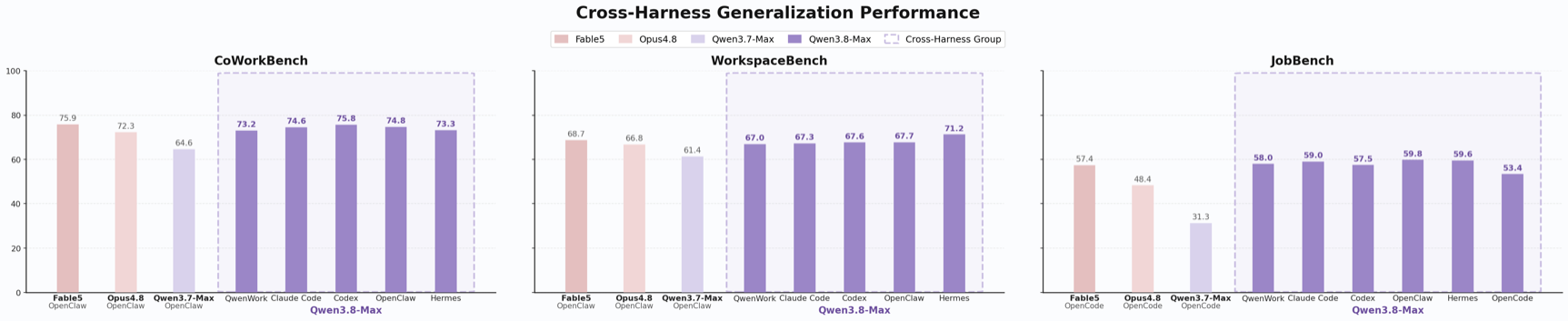
In Alibaba’s tests, the model maintains equivalent performance regardless of the tool used to drive the tasks.
Three reasoning levels are offered: xhigh, used by default for complex tasks; medium, which balances accuracy and speed; and low, aimed at reducing cost and latency. Reasoning preservation between messages is also enabled by default.
Qwen 3.8 27B
The open Qwen 3.8 27B version was released this week on Hugging Face under the Apache 2.0 license. It is a dense 27-billion-parameter model with native vision, a 262K-token context — extendable up to 1 million — and control over reasoning levels.
With quantization, it can run on more powerful home computers. Aggressive configurations already work on cards with 16 GB of VRAM, while GPUs with 24 or 32 GB and Macs with at least 32 GB of unified memory offer more room for context. This puts the model in the same territory as the 26B and 31B Gemma 4 models, holding up well especially for general use.
The initial reception also brought a recurring criticism: the model “thinks too much.” Users report unnecessarily long reasoning chains even for simple requests. Part of the behavior seems to be related to the xhigh level adopted as the default; switching to medium or low, or turning off reasoning mode, can make responses faster. Still, some consider this insistence an advantage in difficult projects, where the model tends to review its own work before delivering the result.