With impressive consistency, Z.ai didn’t even let the dust settle on GLM-5.3 before announcing its next model. This week, the Chinese giant launched GLM-5.3-Flash, the compact, cost-effective version of the GLM-5 family. The highlight of the official announcement: the model not only inherits the current generation’s architecture but surpasses GLM-5.2, the company’s previous model, on virtually every benchmark.
Model type
GLM-5.3-Flash is an MoE (Mixture of Experts) model with 320 billion total parameters, but only 18 billion active per token during inference. For context, its direct predecessor, GLM-5.2, activated 40 billion parameters for every token processed.
Hybrid architecture: less memory, more context
One of the most relevant technical novelties in GLM-5.3-Flash is the combination of two attention architectures: linear and sparse. In plain terms: linear attention handles local text dependencies, while sparse attention ensures the model captures relevant connections across the global context.
To manage such long contexts without blowing up memory costs, the model uses a technique called IndexPool, which compresses groups of key vectors to reduce latency and memory usage at runtime. The result, according to Z.ai, is a roughly 3x reduction in attention compute cost and a KV cache 4.4x smaller compared to the conventional GLM-5.3.
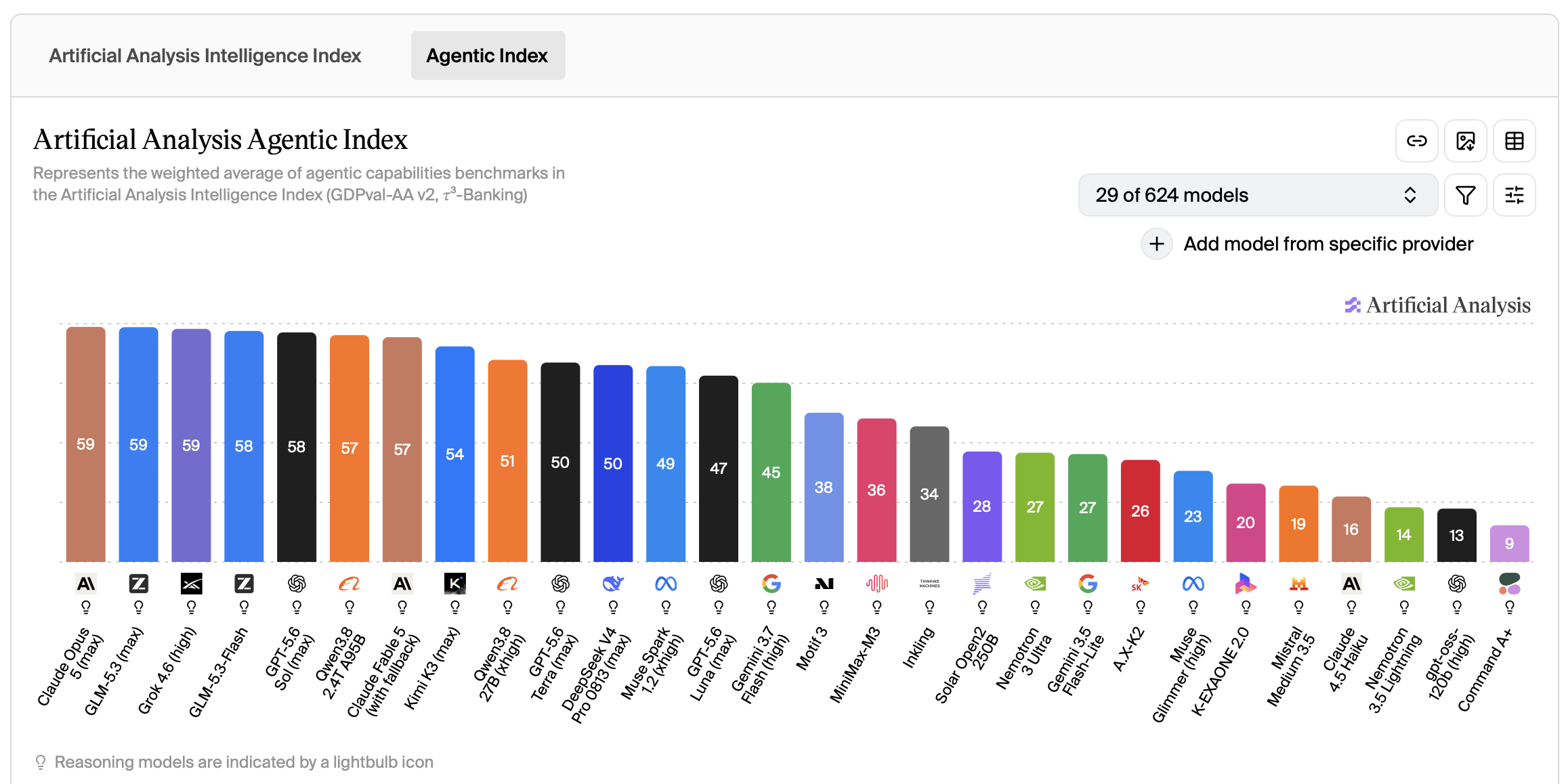
On the Artificial Analysis Agentic Index, GLM-5.3-Flash ranks among the top models, alongside Claude Opus 5, GLM-5.3, and Grok 4.6.
Performance: tying with models that cost far more
On the Artificial Analysis Intelligence Index, an independent industry reference for comparing models by intelligence, GLM-5.3-Flash scored 57 points — the same score as OpenAI’s GPT-5.6 Terra. While GPT-5.6 Terra costs around US$ 0.51 per task on that same index, GLM-5.3-Flash does the same work for US$ 0.09.
To put it in perspective: the model also outscores Gemini 3.7 Flash (56 points) and DeepSeek V4 Pro (~53 points) in intelligence — models widely used in the market as cost-effectiveness references.
On Z.ai’s own benchmarks, GLM-5.3-Flash scored 63.4 points on DeepSWE versus GLM-5.2’s 46.2, and 48.8 on AutomationBench versus just 26.2 for its predecessor. On agentic tasks evaluated by GDPval-AA v2, the model reached an Elo of approximately 1770, tying with GLM-5.3 itself and Grok 4.6 — trailing only Claude Opus 5.
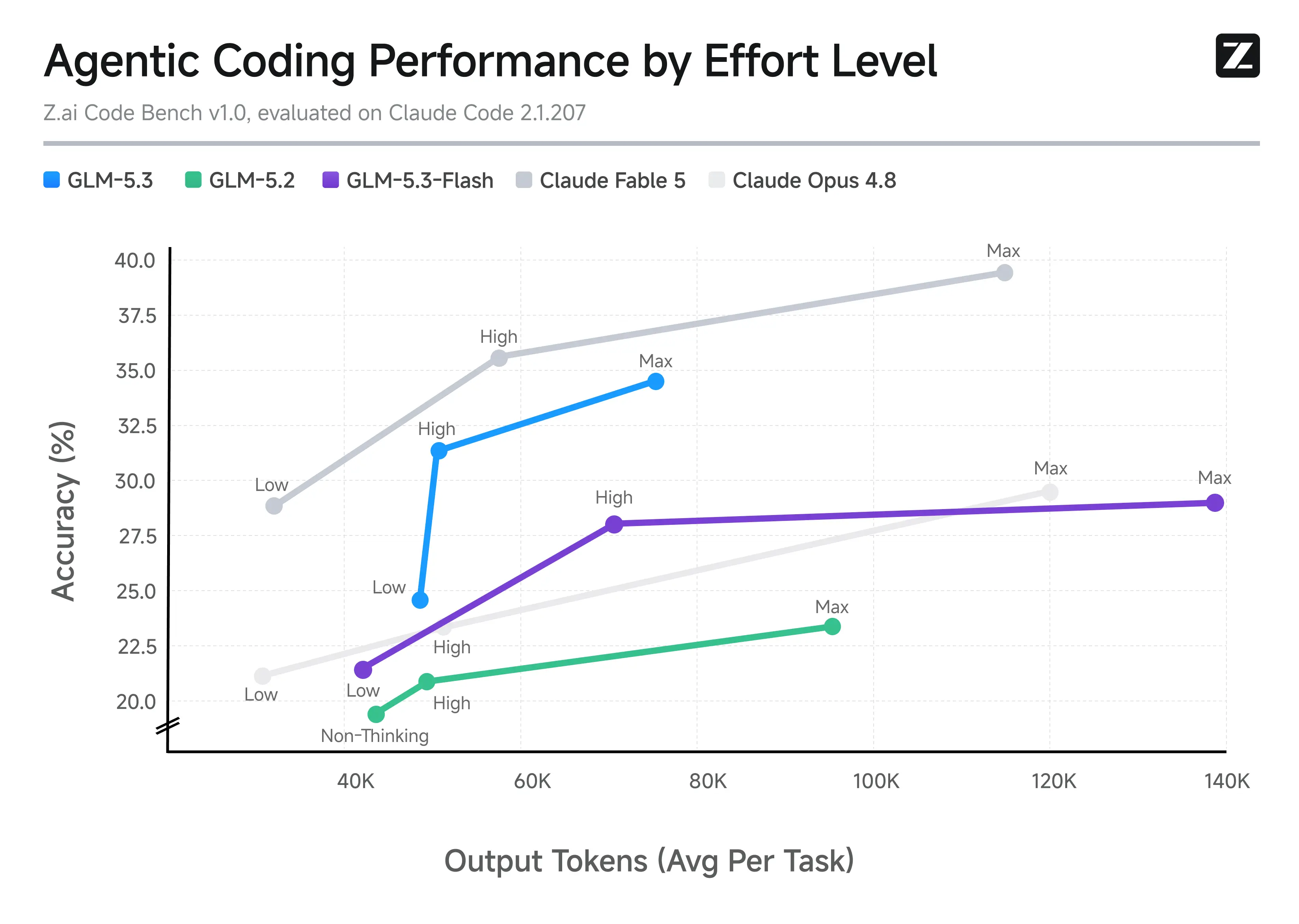
On Z.ai Code Bench v1.0, evaluated on Claude Code 2.1.207, GLM-5.3-Flash (purple) outperforms GLM-5.2 at every effort level while consuming fewer tokens per task.
Cost: cheaper than Anthropic’s “basic” model
GLM-5.3-Flash costs US$ 0.15 per million input tokens and US$ 0.50 per million output tokens on the Z.ai API. For comparison: Claude Haiku 4.5, the most affordable model in the Anthropic lineup, costs US$ 1.00 per million input tokens and US$ 5.00 per million output tokens — 6.7x and 10x more expensive per token, respectively.
The secret identity: “Ox Alpha”
Before the official launch, GLM-5.3-Flash spent an entire week running completely anonymously on OpenCode and OpenRouter under the codename “Ox Alpha.” Even without knowing which model it was, the community quickly adopted it, and it became the most-used model of the week on both platforms. Only then did Z.ai confirm its identity and announce the official launch. A rather elegant way to run a blind market test at real scale.
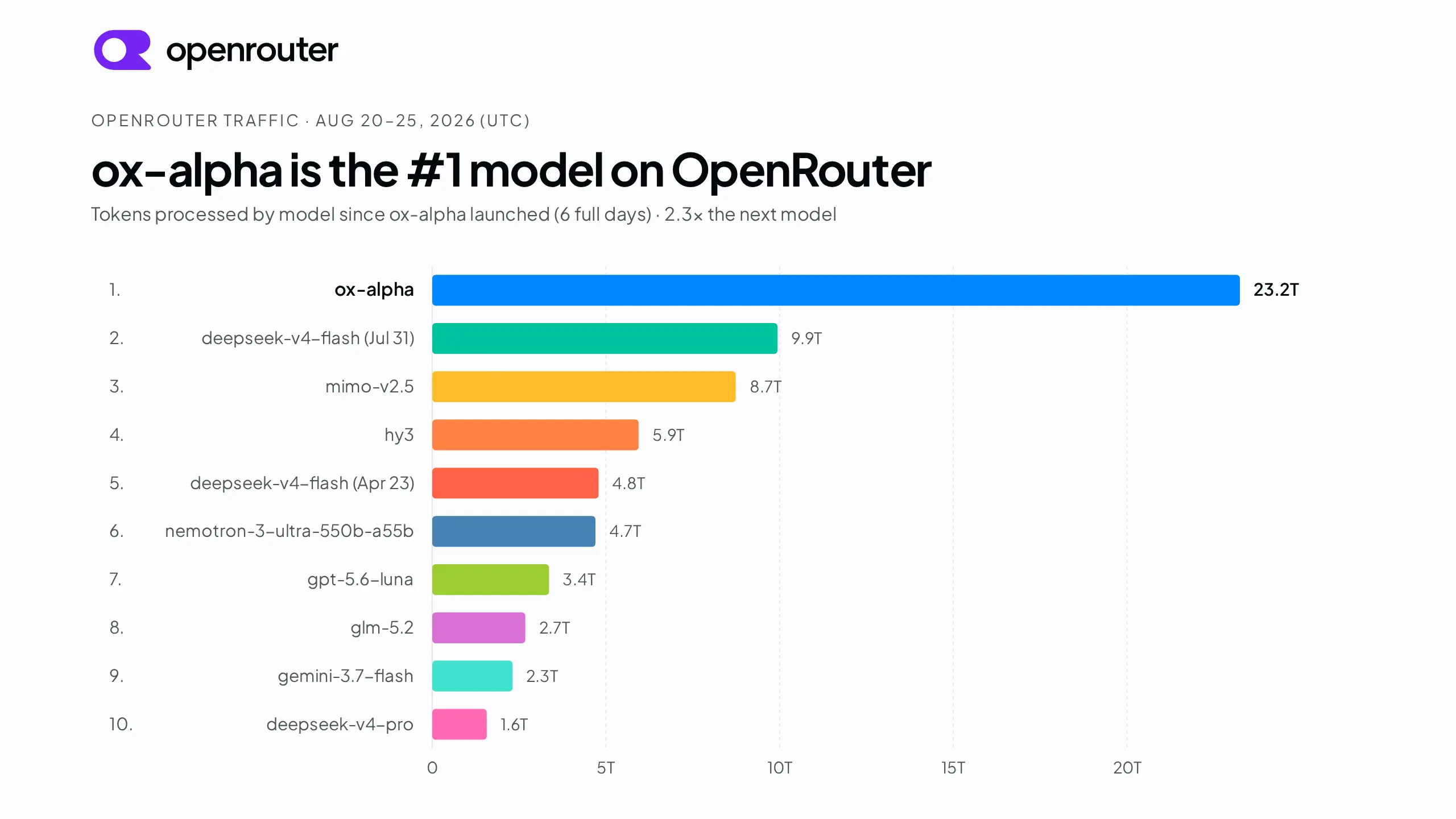
Under the codename “ox-alpha,” the model processed 23.2 trillion tokens in six days on OpenRouter — 2.3x more than the runner-up.
Served entirely on Chinese chips
All of these results were delivered on infrastructure composed exclusively of Chinese-made chips, in a large-scale cluster. Z.ai built its own stack based on SGLang, separating the encoding, prefill, and decoding stages to extract maximum efficiency from domestic accelerators. The result was a 3x gain in serving performance across tens of thousands of accelerators.
In the words of the company’s official documentation:
“This demonstrates that Chinese chips can support frontier-model inference efficiently and economically at scale.”
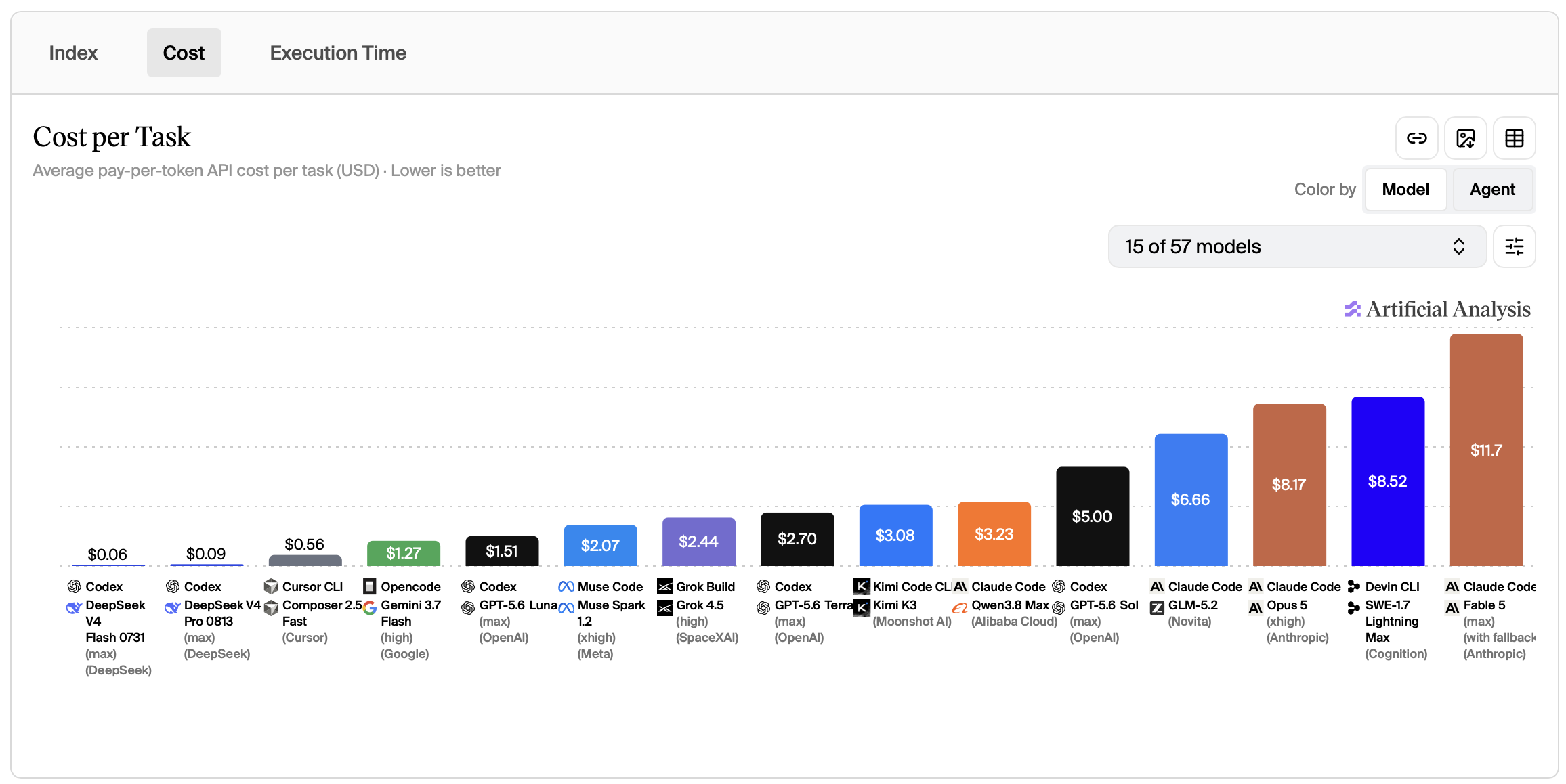
In Artificial Analysis’ cost-per-task comparison, the most economical models run tasks for cents, while configurations with Claude Opus 5 or Fable 5 exceed US$ 8.
Visual intelligence: for real, not as an add-on
Something that has been drawing more and more attention in recent launches in general is integrated visual intelligence. GLM-5.3-Flash represents a relevant step in that direction. Unlike models that “bolt on” vision as an additional capability, here vision is native from pre-training, part of the same stack that processes text.
This matters especially for those who work with interface development, slide editing, or visual debugging: the model can actually “look” at a screenshot and reason about it the way a human would — identifying layout errors, understanding component hierarchy, comparing UI states before and after. Z.ai’s documentation highlights that the model can turn screenshots, screen recordings, and website URLs into functional front-end applications, going beyond simple visual reproduction to understand design systems, interaction states, and animation logic.
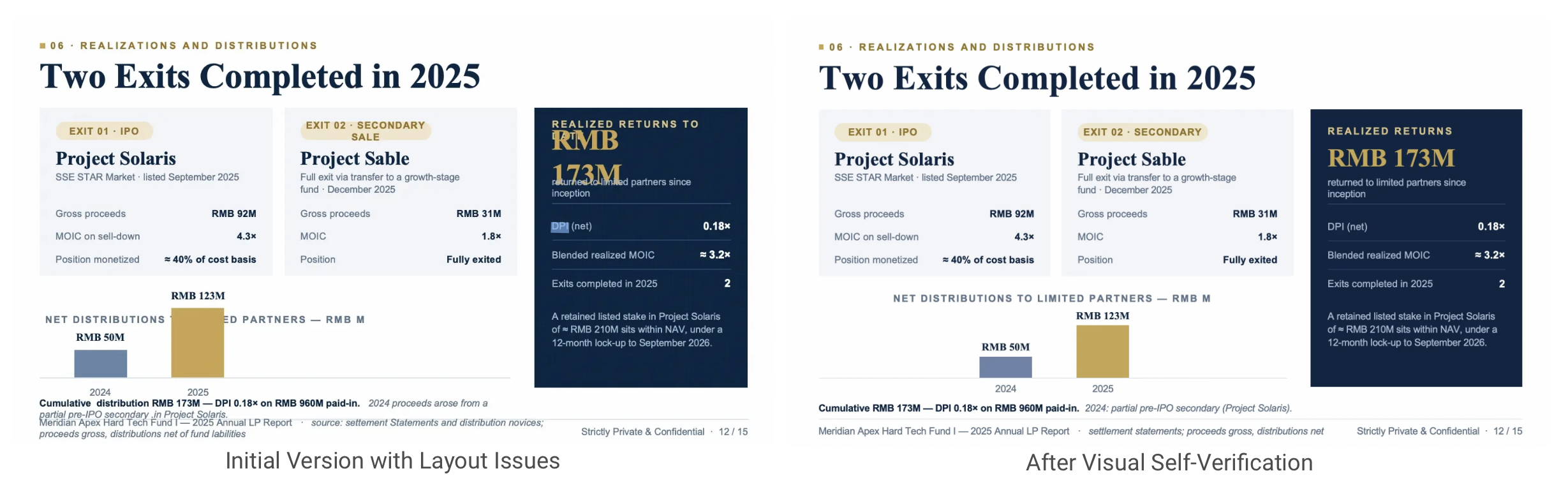
Example from the official documentation: on the left, the initial version of a slide with layout issues; on the right, the result after the model’s visual self-verification.
Availability
GLM-5.3-Flash is available now to all GLM Coding Plan users from Z.ai, with 3x the GLM-5.3 quota. The model is also on chat.z.ai, ZCode, and AutoClaw.
For those who want to self-host, the weights are available on Hugging Face under the MIT license: commercial use is allowed for anyone with the necessary infrastructure (approximately 306 GB in FP8 with Hopper GPUs or newer).