After months of shipping only Flash models, Google introduced Gemini 4 Argon and, two weeks later, Gemini 4 Carbon, which took first place on the Artificial Analysis Intelligence Index.
Google is back
On Wednesday, October 28, Google announced Gemini 4 Carbon, its new frontier model. The launch comes just two weeks after Gemini 4 Argon and has already put the company in first place on the Artificial Analysis Intelligence Index, ahead of Claude Opus 5.5 and GPT-6 Astra.
Two frontier models in less than a month mark a change of pace. For much of 2026, Google didn’t have a model that could compete for the top spot with Anthropic and OpenAI. Now the company is back at the center of the conversation.
Months of Flash
Google’s last frontier model before Gemini 4 was Gemini 3.1 Pro, released in February. Since then, the company focused its releases on the Flash line, built for speed and low cost.
The most important of these was Gemini 3.5 Flash, introduced at Google I/O 2026 in May. Google promised answers up to four times faster than other frontier models, and the model delivered on that: it was fast and cheap, but it didn’t threaten the leaders on intelligence. Over the following months came Gemini 3.6, 3.7, and 3.8 Flash, incremental updates to the same family. For reference, Gemini 3.8 Flash scores 31 points on the Artificial Analysis index, a little over half of Claude Opus 5.5’s 58.
On the local side, the news was Gemma 4 12B, released in June. It’s an open 12-billion-parameter model under the Apache 2.0 license that understands text, images, and audio and was designed to run on laptops with 16 GB of memory.
Gemini 4 Argon
Gemini 4 Argon was announced on September 30, with a focus on software engineering, knowledge work, and cyber defense. Among the new features, the output limit jumped from 64,000 to 1 million tokens. At first, however, access was limited to a group of cybersecurity specialists through Fairwind, Google’s security program.
The wider rollout came on October 13. Argon arrived in the Gemini app and in AI Mode in Search for Google AI Pro and Ultra subscribers, and in the API for developers, at an introductory price of $2 per million input tokens and $10 per million output tokens. In the app, the model brought more direct answers, a tasks mode that keeps working even when you’re away from your computer, and connections to more than 40 apps.
Pro subscribers push back
The problem was Antigravity, Google’s agentic coding tool. There, Argon was released only for the Ultra plan, the most expensive one. Pro subscribers took to Google’s forums to complain: according to them, the model had been marketed to Pro but was locked precisely in the tool where it would make the biggest difference. Some pointed out that Gemini 3.1 Pro had already been removed from Antigravity, leaving the plan with only Flash models, and a few called it a bait-and-switch.
Two days after the launch, on October 15, Google rolled out Argon in Antigravity to Pro, with a separate weekly quota. The complaints didn’t stop entirely: users kept reporting that a few prompts with Argon were enough to use up the limit.
Gemini 4 Carbon
Carbon is a direct evolution of Argon. According to Google, the quick launch was made possible by close collaboration between researchers and the models themselves, and it incorporated user feedback on the previous version. The company hasn’t disclosed the model’s size or architecture details.
The improvements span coding, agents, science, web development, and multimodal understanding. Carbon was built for long-running work: Google says that, internally, the model has worked for days on end, getting past dead ends until it found and fixed the root cause of bugs in large codebases.
Compared with Argon, Google highlights:
- Twice the success rate in generating secure code, in internal tests.
- Half as many unsupported claims.
- A 26% reduction in cases where the model does more than it was asked and a 29% reduction in cases where it delivers less.
- When instructions are ambiguous, the model looks up relevant sources and flags discrepancies before acting.
Cybersecurity is still the flagship. Carbon scores 88.2% on SEC-bench Pro, which measures the ability to find vulnerabilities, 54.8% on ExploitGym, which covers exploitation, and 71% on CWE-bench, which evaluates fixing the root cause of problems.
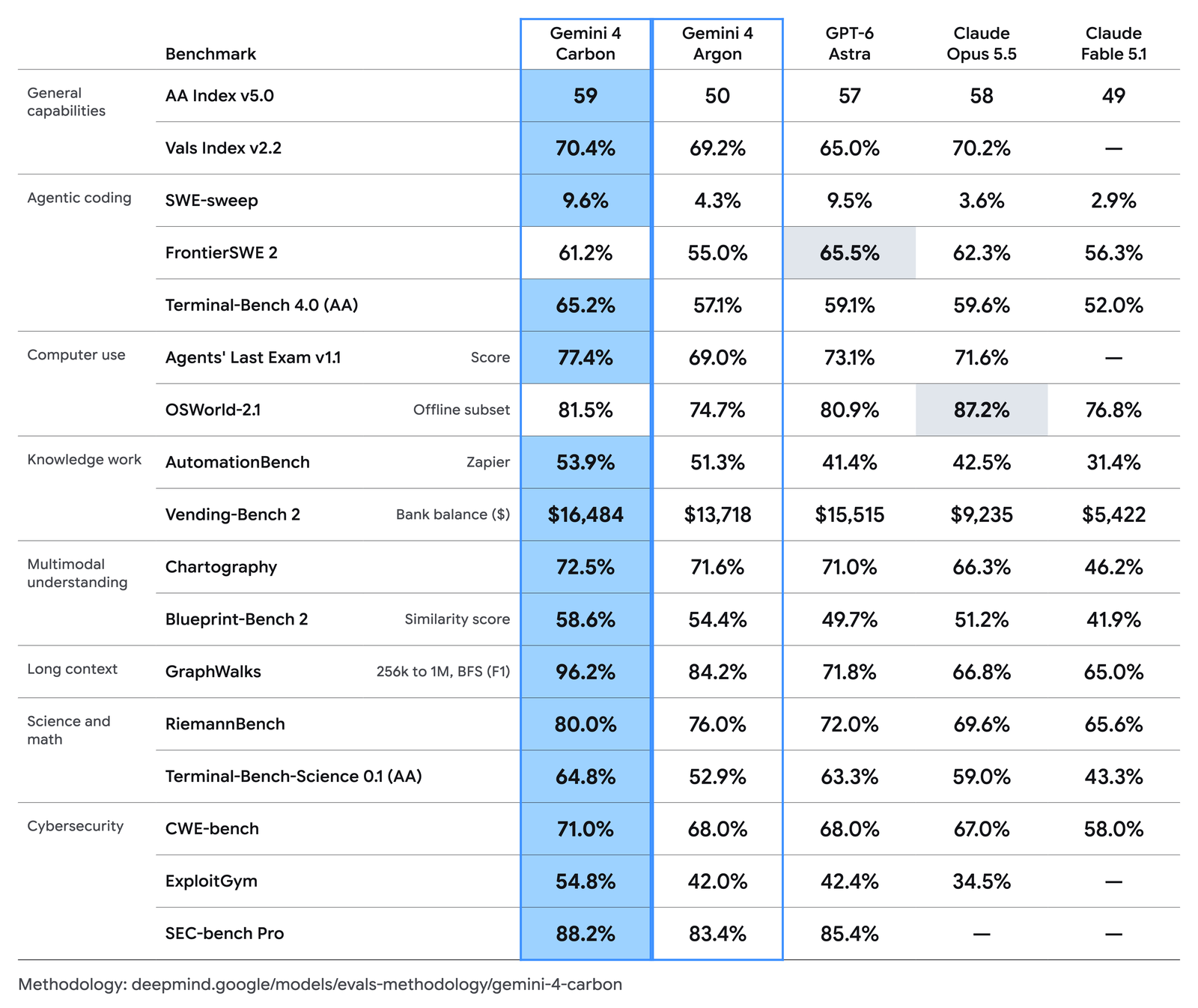
Benchmarks published by Google. Carbon leads most tests, but trails GPT-6 Astra on FrontierSWE 2 and Claude Opus 5.5 on OSWorld-2.1.
The jump over Argon is big for a two-week gap. On Terminal-Bench 4.0, the score went from 57.1% to 65.2%. On GraphWalks, which tests long contexts from 256,000 to 1 million tokens, it went from 84.2% to 96.2%.
What Artificial Analysis says
Artificial Analysis is one of the main independent references for comparing AI models. Version 5.0 of its intelligence index combines nine evaluations, ranging from terminal coding to scientific reasoning and general knowledge.
On this index, Gemini 4 Carbon (high) ranks first with 59 points. Right behind it are Claude Opus 5.5, with 58, and GPT-6 Astra, with 57. According to Google’s table, Argon scored 50, which means Carbon gained nine points in two weeks.
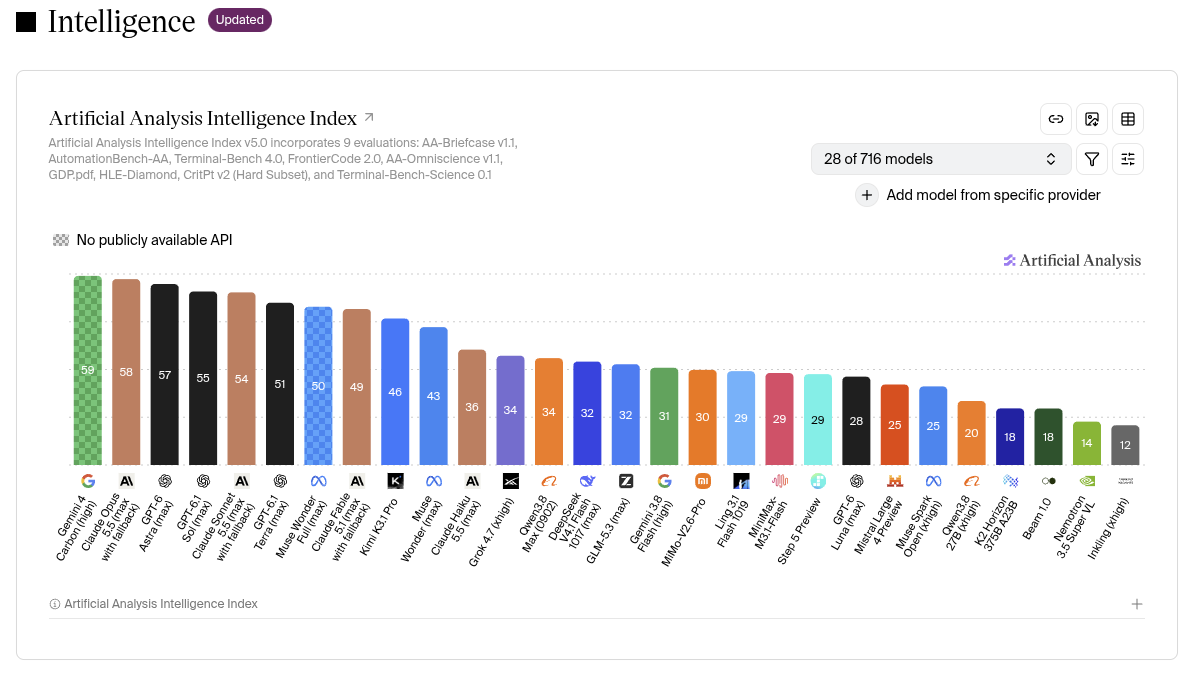
The checkered bar means Carbon doesn’t have a public API yet: Artificial Analysis evaluated the model before its release.
The cost also stands out. To complete the index tasks, Carbon spends an average of $7.76 per task. That’s less than Claude Sonnet 5.5 and Qwen 3.8 Max ($10.02 each), Claude Opus 5.5 ($10.04), and Claude Fable 5.1 ($13.04). It even comes in a cent below Gemini 3.8 Flash itself ($7.77) and not far from GPT-6 Astra ($6.24).
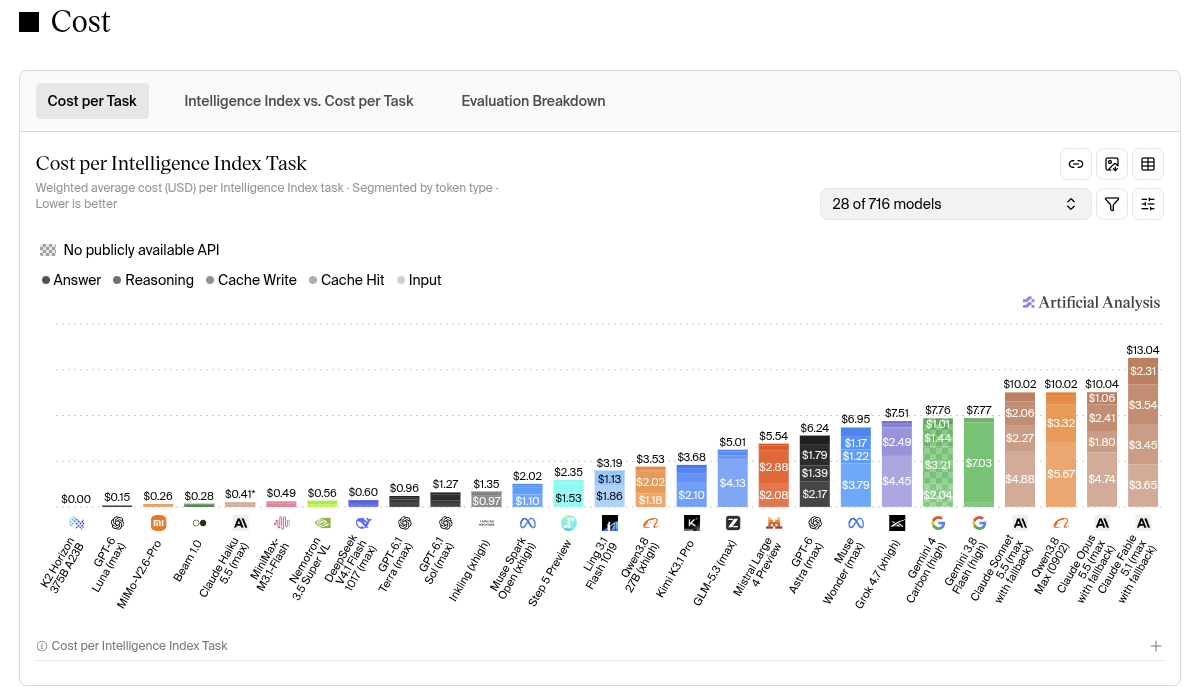
Average cost, in dollars, per intelligence index task. Lower is better.
The results in agentic coding are strong too. On the Coding Agent Index, which evaluates the combination of model and tool, Carbon running in the Antigravity CLI scores 59 points. It trails only Claude Code with Opus 5.5, at 62, and ties with Claude Code with Sonnet 5.5 and Muse Code with Muse Wonder Full. Argon, in the same tool, scored 53.
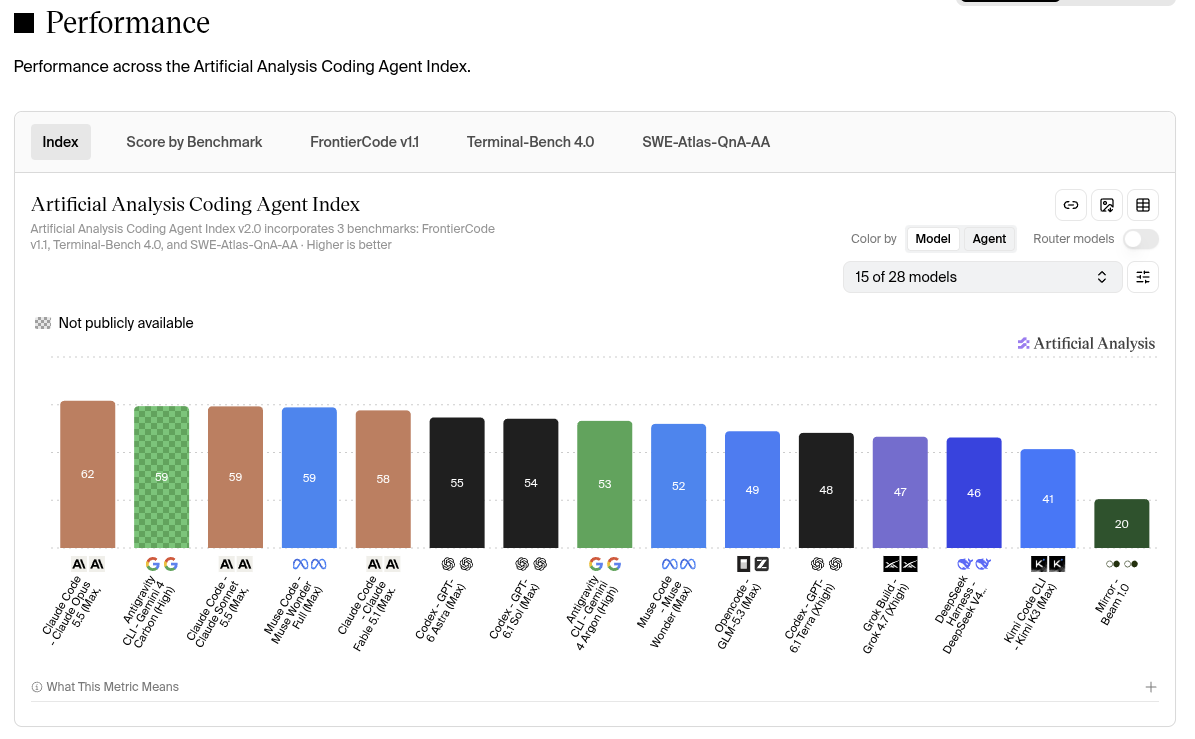
Artificial Analysis Coding Agent Index, which combines FrontierCode, Terminal-Bench 4.0, and SWE-Atlas-QnA.
Availability and pricing
Despite the numbers, Carbon isn’t open to the public yet. Google is taking a phased approach and is participating in the US government’s voluntary pre-release testing process:
- This week, access starts with a group of cybersecurity specialists.
- Then it gradually expands to more partners in the Fairwind program.
- Finally, the model reaches developers, businesses, and consumers “as soon as possible,” according to Google, after more rounds of feedback and safety adjustments.
Pricing follows Argon’s: $2 per million input tokens and $10 per million output tokens during the introductory period, with a 95% discount on cached input tokens. After that, prices rise to $4 and $20.
Google hasn’t said yet which Gemini app plans Carbon will appear in. After the controversy over Argon in Antigravity, that’s an answer Pro subscribers will want to watch closely.