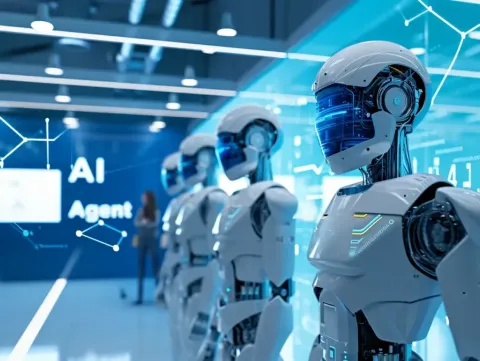
Artificial Intelligence (AI) agents bring new possibilities for automation and interaction with data and users in a simple and intuitive way. But what exactly are these AI agents, and how do they impact various sectors?
Definition of AI Agents
An AI agent can be defined as an autonomous system that uses artificial intelligence algorithms to perform actions in a specific environment, with the goal of achieving objectives or solving problems. These agents are designed to interact with the environment they are placed in, making decisions based on available information and accumulated learning.
AI agents are widely used to automate tasks and improve processes, from simple tasks like answering frequently asked questions on e-commerce sites to more complex solutions, such as predicting market behaviors in financial systems.
Practical Applications of AI Agents
AI agents have a wide range of practical applications across various sectors. They are especially valuable in areas where automation and the analysis of large volumes of data are critical for efficiency and success. Here are some examples of where AI agents are being used today:
- Virtual Assistants: Agents like Alexa, Siri, and Google Assistant are popular examples of AI in people’s daily lives. They respond to voice commands, provide information, and even control smart home devices.
- Customer Service Chatbots: Companies across all sectors are implementing AI-powered chatbots to provide real-time customer support. These agents are capable of answering common questions, resolving basic problems, and, in some cases, even understanding the context of more complex conversations.
- Industrial Process Automation: In factories and industrial environments, AI agents are used to optimize production lines, monitor equipment, and predict failures, improving operational efficiency and reducing costs.
- Financial Systems: In the financial market, AI agents are being used to analyze market data and help predict trends. They can also be used to automate transactions and detect fraudulent activities.
- Healthcare: In the healthcare field, AI agents are helping doctors diagnose diseases, recommend treatments, and even monitor patients in real-time, providing more personalized and accurate care.
The Future of AI Agents
The advancement of AI technology is enabling the creation of increasingly sophisticated agents. The ability of these systems to learn from data and adapt to new situations means that, in the future, we will see AI agents even more integrated into our daily lives, automating more complex processes and assisting with critical decisions.
In the business field, for example, AI agents can help companies create more effective marketing strategies, automate financial operations, and even develop new products based on consumer behavior patterns. In personal life, virtual assistants will continue to evolve to become smarter and more proactive.
LangChain and AI Agents
LangChain is a framework for building AI applications and agents that allows you to create autonomous systems or services where the AI decides which data or tool to use, being able to make HTTP calls, query databases, and JSON APIs to fetch the necessary information to perform the action requested by the user.
With frameworks like LangChain, we can develop AI assistants that respond with reliable and accurate data based on project data.
AI agents are intelligent systems designed to automate tasks, improve process efficiency, and make decisions autonomously. Their applicability ranges from simple virtual assistants to advanced solutions in sectors like healthcare, finance, and industry. As AI technology continues to evolve, agents will become even more indispensable in our daily lives, transforming the way we live and work.
This technological revolution is just beginning, and the future of AI agents promises to bring even more innovation and progress to all sectors of society.